What Charles Darwin teaches us about Marketing
Recently, I read the book Cosmos, by the genius Carl Sagan. In one passage, he explains the theory of natural evolution and artificial evolution.
The natural evolution of species occurs when environmental factors end up favoring individuals with certain characteristics over others, so that the former tend to survive and produce more offspring than those in the latter group.
Artificial evolution, on the other hand, is induced by human action. Carl Sagan gives an interesting example:
Crabs in a certain region of Japan have markings on their shells that resemble a human face, and this has a curious explanation. In that region, many boats carrying samurai were shipwrecked. Fishermen believed that crabs with those markings on their shells carried the spirits of the drowned samurai, and therefore returned those crabs to the sea. Crabs that did not have the markings were normally captured, causing, through human influence, a particular lineage of crabs to become predominant over the others.
Okay, but let’s talk about Marketing.
Until some time ago, I believed that for Google and other search engines to recognize a domain as an authority on a given subject, prioritizing it in search results, it was important to have many articles and pages with the keywords of interest (those we want to appear for in searches). As I progressed in my studies and practical experiments, I realized that this strategy can lead to redundant and often shallow content.
Once Google understands the central topic of a website/domain,the best thing to do is to increasingly deepen the content, making the most important pages much more complete than those of competitors and adding internal links to complementary pages that are connected in a coherent and organized way.
But how do we know which pages and keywords deserve an investment of time and effort so that the content can be enriched with greater depth and/or complementary pages?This is where the theory of evolution comes into play!
The “environment” we want to optimize our content for is Google, and it gives excellent clues about which characteristics should be predominant. We can start by exporting the detailed report that Google Search Console provides.

In this report, under the “queries” tab, it is possible to see impressions, clicks, and the position our domain holds for certain keywords of interest.
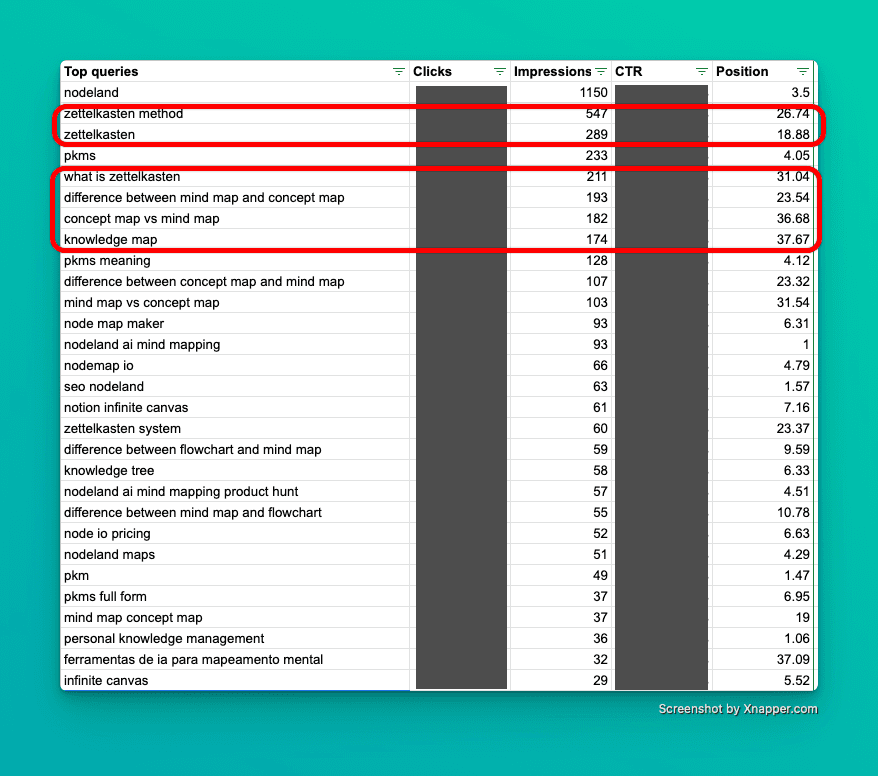
Now, notice what is highlighted in red. These keywords had a very high number of impressions even though they were very poorly positioned (second or third page of Google).
This means there is strong demand for this content! If we manage to rank it better, the number of visitors to the site will likely grow exponentially.
Based on this information that the environment (Google) has given us, we should evolve pages related to topics that have a high number of impressions (high demand) so they don’t die (remain unseen).
Wow, isn’t this pure Darwinian theory applied to content strategy?!
Pages that adapt to demand survive. Pages that don’t, disappear.
Now think with me:
This parallel I tried to draw between the theory of species evolution and SEO optimization can actually be extended to almost any subject. The truth is that positive and consistent results, in any imaginable context, are generally the result of repeated iterations. After each iteration, we should take what works and double down on it. This is what tends to leverage positive results in an increasingly accelerated way (compound interest in action).
And what about what doesn’t work?It needs to go through variations until it reaches a form that works better within the given environment.